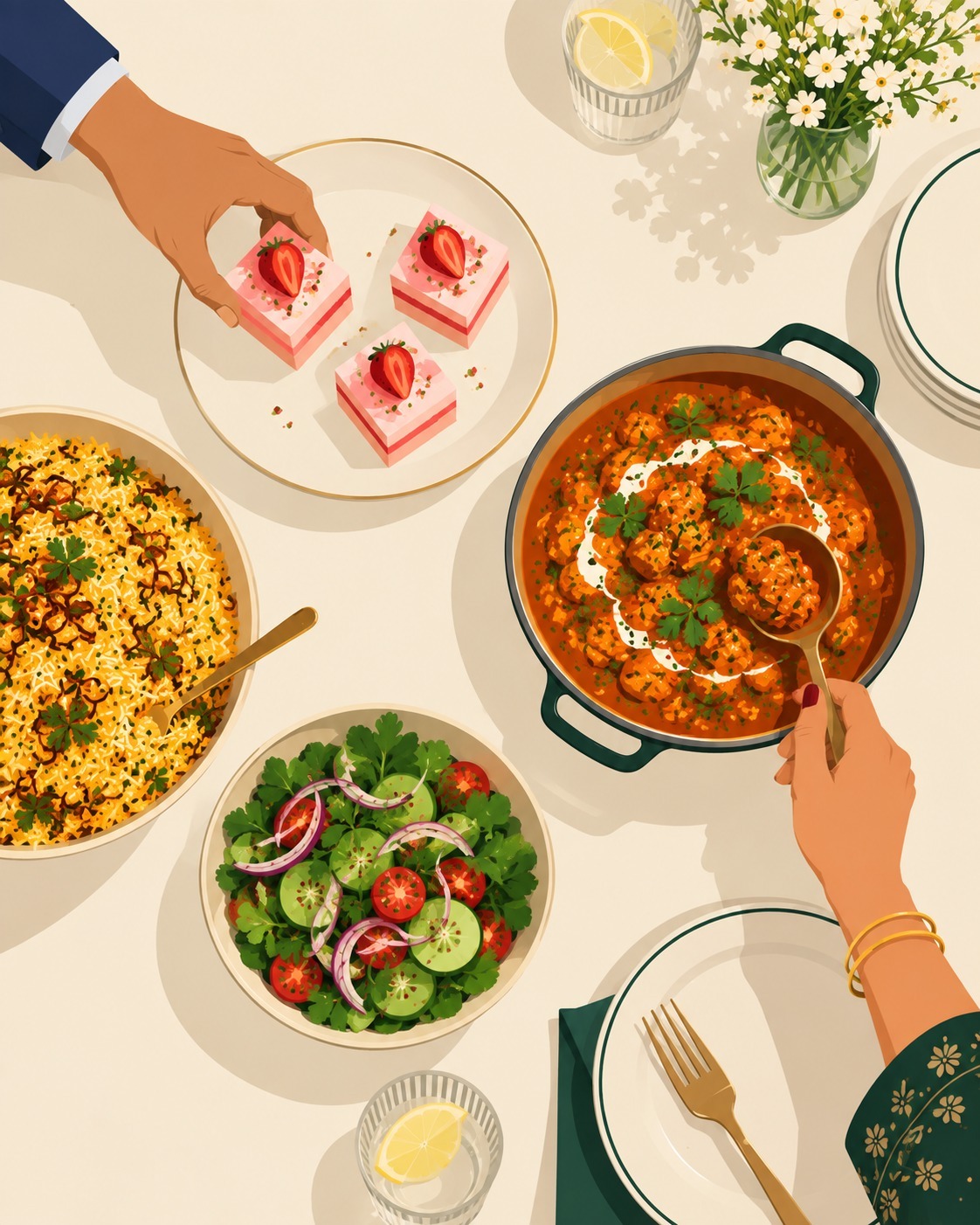

“Try the lighter dishes. The heavier ones are more for the boys.”
Everyone laughed. Harmless humour, right?
Perhaps. But such casual remarks often reveal how easily we attach gender to food. We do it with portions, flavours and even colours. Salads are called “light”. Meat is “hearty”. Desserts are “dainty”. Spice is “bold”. Somewhere along the way, food begins carrying identities it never asked for.
Dessert, too, can apparently become a matter of gender.
Arjun reaches for a bright pink pastry.
There is a brief silence before someone laughs. “That one?”
He raises an eyebrow. “Why? Has the pastry asked for my gender?”
At the other end of the table, Meera fills her plate with a richly spiced, dark-coloured curry.
Someone looks at her in mock surprise. “That looks rather… strong.”
She smiles. “Apparently, so am I.”
It sounds exaggerated, but researchers have long studied the way foods are marketed and perceived through gender — with meat, larger portions and stronger flavours often coded as masculine, while salads, smaller portions and sweeter or “lighter” foods are more often coded as feminine.
Even colour carries cultural baggage. Pink, for instance, was not always considered a “girl’s colour”; those associations shifted over time. What feels completely natural to us today may simply be something society taught us to see that way.
We talk about breaking stereotypes in clothing, careers and colours, yet food often escapes the conversation. Without realising it, we continue to classify dishes as delicate or hearty, light or strong, feminine or masculine.
But food has no gender.
A pastel dessert does not become feminine because of its colour. A spicy curry does not become masculine because of its appearance. And choosing either says nothing about the person holding the plate.
Perhaps it is time we stopped assigning identities to our food.
After all, a meal should nourish the person sitting at the table — not the stereotype sitting beside them.